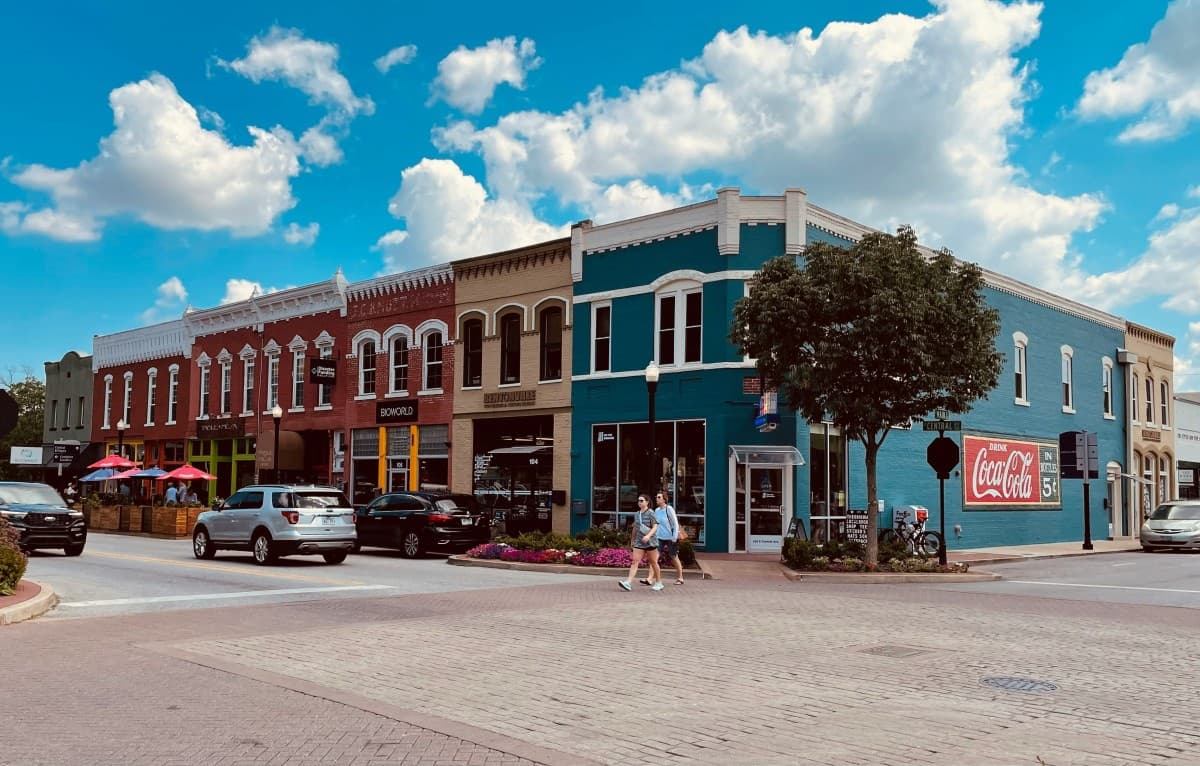
Bentonville, AR
Northwest Arkansas has a way of expanding without losing its bearings. The region’s identity is still tied to the Ozarks—trailheads, lake weekends, and neighborhoods that feel more like towns than “markets”—but 2025 made clear that the area is no longer growing quietly. What changed wasn’t only attention from the outside; it was how consistently demand showed up across Benton and Washington counties, and how quickly the region’s housing and lifestyle infrastructure were asked to keep pace.
The strongest, most widely cited snapshot of the year came from the Arvest Skyline Report covering the first half of 2025. Home sales rose 5.2% year over year to 5,049 closings, and the report noted a milestone: it was the first time since the Skyline series began in 2004 that two consecutive half-year periods exceeded 5,000 sales. Price growth moved in step. Average home prices reached $471,427 in Benton County (up 8.9% year over year) and $417,489 in Washington County (up 7.2%), reinforcing that this was not simply volume—it was continued repricing of the region.
Construction remained a meaningful share of that story. Residential permits increased 11.3% year over year to 2,929, and newly built homes accounted for 36.5% of sales in the first half of 2025. Inventory, while still a constraint in many price bands, began to loosen compared with the tightest period of the cycle: the Skyline coverage cited MLS listings rising from 1,591 in the first half of 2023 to 2,670 in the first half of 2025. At the same time, the report flagged the region’s next pressure point—infrastructure capacity, particularly sewer, as a potential limiter on future development in several fast-growing cities.
SUBSCRIBE TO THE HAVEN MAILING LIST
Curated homes, market intelligence and design stories — a few emails a month.
No spam. Unsubscribe any time.


If the housing market explains the pace, the lifestyle case explains the staying power. Northwest Arkansas continues to build a daily-life infrastructure that makes growth feel less like sprawl and more like a network. The Razorback Regional Greenway—a 40-mile paved corridor connecting communities from Fayetteville north through Bentonville and beyond—has become a backbone for commuting, recreation, and the region’s broader outdoor identity. And on the cultural side, one of the most concrete signposts on the 2026 horizon is Crystal Bridges’ expansion, scheduled to open June 6 and 7, increasing the museum’s footprint and reinforcing Bentonville’s role as a national-scale arts destination.
Looking toward 2026, the forecast reads less like a pivot and more like a continuation—just with a different set of constraints. Population growth is still routinely described in the high-30s per day, which keeps housing demand elevated even as affordability becomes a more central question. Nationally, rate forecasts have generally pointed to gradual easing rather than a dramatic reset, which matters because even small moves can change the number of sellers willing to list and buyers willing to stretch. In Northwest Arkansas, though, the defining variables may be local: whether infrastructure keeps up, whether new supply arrives in the right places and price points, and whether the region can preserve the very qualities—access to nature, livability, and a sense of community—that made it desirable in the first place.
The story now is refinement. Northwest Arkansas doesn’t need to prove it can grow; 2025 did that. The more interesting question for 2026 is how well it can manage the pace—directing investment toward the systems that make a fast-growing region feel not just successful, but sustainable.