
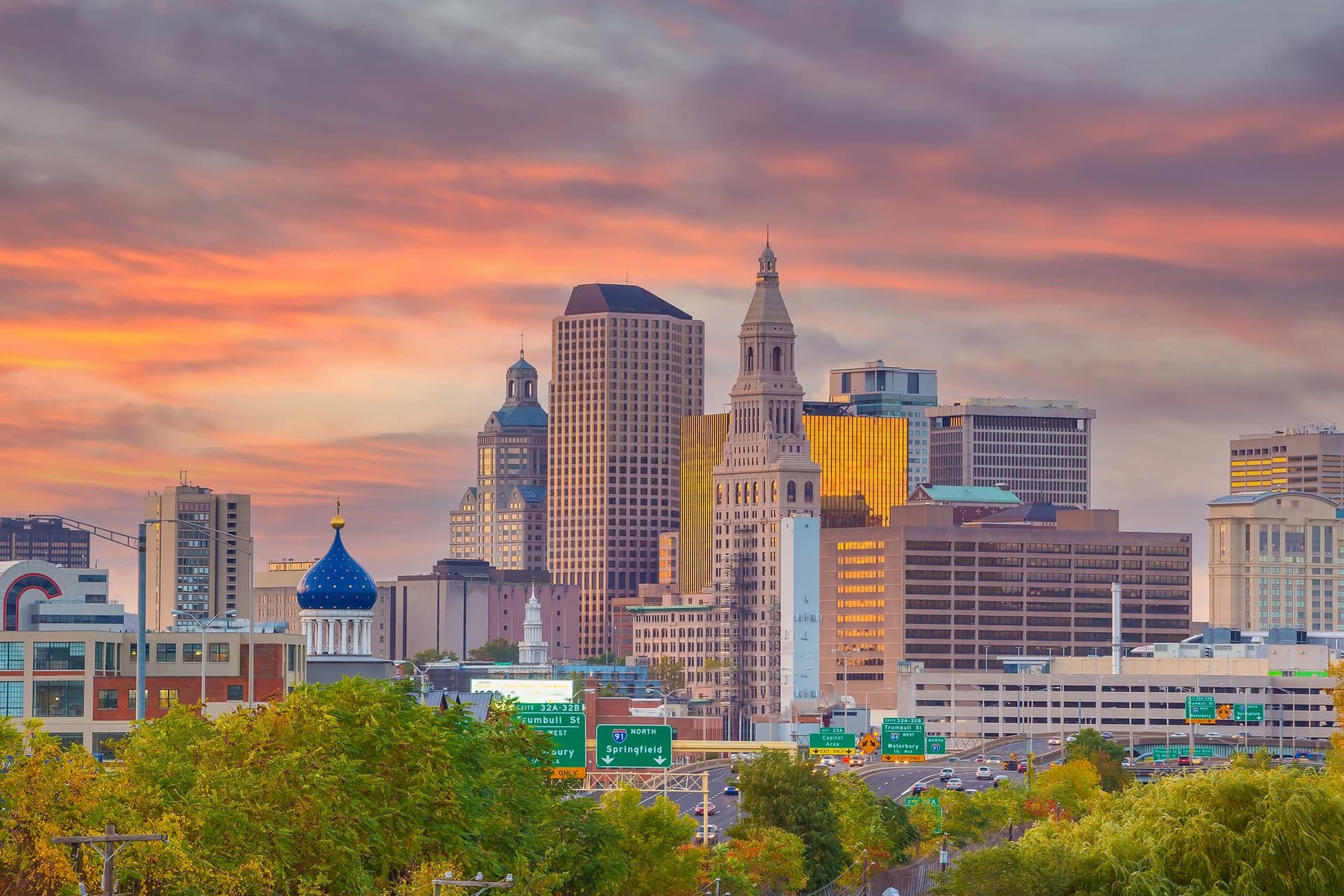
Hartford, CT | photo by f11photo/Shutterstock.com
When Zillow released its list ranking the top 10 housing markets for 2026 in the U.S., Hartford and Buffalo were at the top, major metros like New York, Boston, Los Angeles, and San Jose make appearances (alongside Philadelphia), and most Midwest and Sun Belt standouts that dominated earlier hot-market cycles are absent — with Milwaukee the lone Midwest entry. Taken together, the list suggests a market no longer driven by urgency or experimentation, but by consolidation around places that already work. Read that way, the ranking also offers insight into the kinds of places—and lifestyles—buyers are increasingly treating as long-term bets.
1. Buyers Are Prioritizing Places With Finished Systems
Across the 2026 list, competition is clustering in cities where the fundamentals of daily life are already solved. Hartford, Providence, Philadelphia, Boston, and New York all share a common advantage: established institutions and job access—plus the kind of day-to-day services and civic capacity that don’t rely on future buildout. These are markets where access to healthcare, education, employment, and transportation doesn’t depend on future development. For luxury buyers in particular, that certainty matters. Demand is flowing toward cities where lifestyle logistics feel predictable, even if the buy-in is competitive.
SUBSCRIBE TO THE HAVEN MAILING LIST
Curated homes, market intelligence and design stories — a few emails a month.
No spam. Unsubscribe any time.
2. Architectural Longevity Is Outperforming Newness
Another unifying feature of the ranking is housing stock that carries visible permanence. Buffalo, Milwaukee, Richmond, Philadelphia, and large parts of Boston and New York offer older homes, historic districts, and neighborhoods shaped over generations rather than rapid development cycles. In these markets, scarcity isn’t just about low inventory — it’s about irreplaceability. Buyers are competing hardest for homes with craftsmanship, proportion, and neighborhood context that can’t be recreated quickly, signaling a shift away from novelty-driven demand toward long-term value.
3. Access Matters More Than Escape
Earlier hot-market cycles rewarded distance from major metros. The 2026 list suggests the opposite. Hartford and Providence benefit from adjacency to Boston and New York, while Philadelphia functions as a full-scale metro that still allows for space and neighborhood identity. Even Buffalo and Milwaukee fit this pattern, offering strong regional connectivity without the density of coastal hubs. Rather than leaving economic centers behind, buyers are choosing locations that keep them connected while reducing day-to-day friction.
4. Major Cities Are Back — but on Stricter Terms
The presence of New York, Boston, Los Angeles, and San Jose doesn’t signal a reversal of recent trends so much as a refinement. Buyers are re-entering major metros selectively, concentrating demand in neighborhoods that offer livability alongside access. In other words, demand isn’t returning to “the city” broadly—it’s concentrating in the most livable pockets. Across these cities, competition is strongest for properties near green space, with efficient layouts and amenities that support hybrid schedules and wellness-oriented living. Scale alone is no longer enough; the winning segments are those that make urban life feel manageable.
The Takeaway
Read as a whole, Zillow’s 2026 ranking reflects a buyer who is no longer chasing the next move, but choosing where to stay. The hottest markets are unified by clarity: established infrastructure, durable housing stock, and cultural life that’s already embedded.